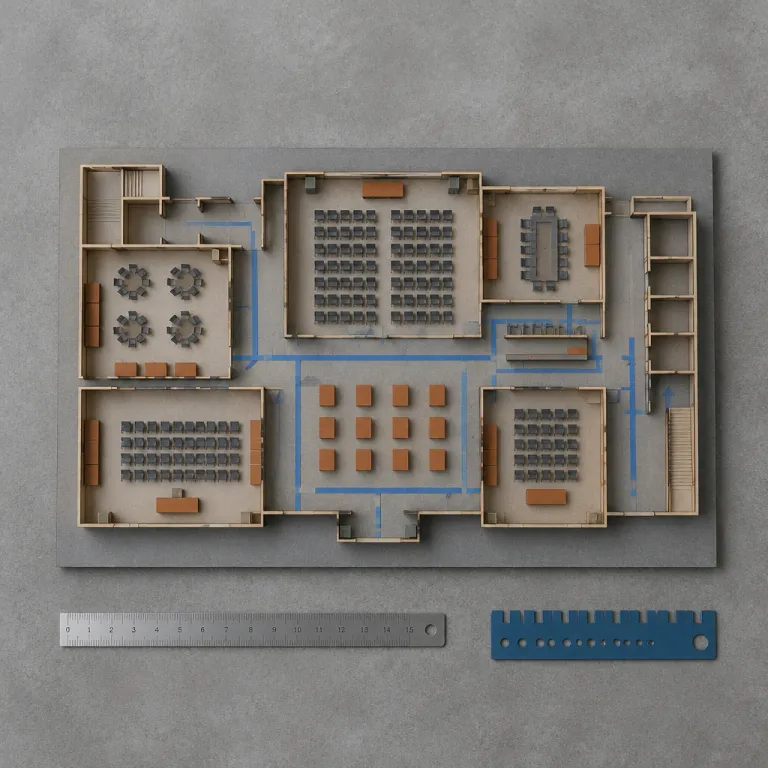
Reading stadshotel den haag event spaces capacity as a strategic MICE indicator
For MICE planners, stadshotel den haag event spaces capacity is never just a number. It is a practical indicator of how a hotel can orchestrate flows of guests, segment programmes, and align meeting formats with commercial objectives. When a property positions itself as a boutique hotel yet offers scalable meeting facilities, it signals a deliberate strategy to attract high value corporate groups rather than volume driven tours.
In The Hague city center, a based hotel such as Fletcher Stadshotel Den Haag sits between embassy districts, business districts, and cultural axes leading to the museum quarter. That location means stadshotel den haag event spaces capacity must flex from confidential board meetings to policy forums, while still preserving the intimacy expected from a star hotel with limited rooms. Event organisers should therefore read capacity data not only as maximum capacity in people, but as a matrix of room combinations, breakout options, and circulation paths for guests during peak time.
When evaluating any hotel, MICE professionals should request detailed data on meeting rooms, including theatre, classroom, and cabaret capacity people figures for each configuration. These capacity metrics must be cross checked with the number of rooms and suites, because a mismatch between sleeping capacity and meeting capacity will create pressure on overflow hotels. In a dense city centre such as The Hague, where travel time between venues is sensitive, stadshotel den haag event spaces capacity becomes a decisive factor in whether a single hotel can host plenary sessions, parallel tracks, and hosted buyer programmes without fragmenting the group.
Aligning rooms, meeting rooms, and guest flows in a boutique city centre context
Stadshotel den haag event spaces capacity only creates value when it is aligned with the inventory of rooms and the expected profile of guests. A boutique hotel with fewer rooms but generous meeting facilities can work perfectly for high level delegations, provided that the organiser controls the rooming list and the arrival patterns. In contrast, a larger star hotel may offer more rooms yet struggle to provide the same level of personalised services for each guest during intense congress periods.
At Fletcher Stadshotel Den Haag, planners should analyse how many meeting rooms can operate simultaneously without compromising food and beverage logistics or room service standards. The hotel restaurant, bar, and any terrace where delegates can enjoy a drink between sessions must be factored into the overall capacity people calculation. When stadshotel den haag event spaces capacity is evaluated in isolation from public areas and back of house facilities, the result is often congestion during lunch dinner peaks and reduced satisfaction in customer reviews.
For destinations and offices de tourisme, positioning a based hotel in the city centre requires a clear narrative about walking distances to the nearest museum, tram stops, and partner hotels. The more precisely you can map guest flows between hotels, venues, and cultural sites, the easier it becomes to sell multi venue programmes to B2B agencies. Case studies from Nordic properties such as Valldal Fjordhotell, whose conference facilities are analysed in depth in this article on boutique meeting capacity in Norway, show how a clear articulation of capacity, rooms, and destination assets can reposition a small hotel as a serious MICE contender.
From raw capacity data to programme design and revenue optimisation
Raw figures about stadshotel den haag event spaces capacity only become operational when translated into programme design scenarios. Event planners should request not just a capacity chart, but several sample layouts showing how many guests can be hosted for plenary sessions, workshops, and networking events across a full day. This approach allows you to test whether the hotel’s meeting facilities can support your content strategy without forcing constant room resets that erode valuable time.
For a property such as Fletcher Stadshotel Den Haag, the combination of a main room, smaller meeting rooms, and semi private corners in the hotel restaurant can unlock creative formats. A based hotel in the city center can, for example, host a 120 person plenary in maximum capacity theatre style, then split into three breakout rooms for parallel sessions, while the bar area is prepared for an evening enjoy drink reception. When stadshotel den haag event spaces capacity is analysed in this dynamic way, the organiser can align sponsorship packages, food and beverage minimums, and room blocks with clear revenue projections.
Commercial hotel teams should also integrate historical data from travel sites and internal CRM systems to understand how different segments use capacity over the term of a contract. A corporate training series will use meeting rooms and catering services very differently from an association congress that fills most rooms but spends more cautiously on food beverage extras. Insights from other properties, such as those outlined in this guide to leveraging meeting room capacity for high impact events, underline how granular capacity planning directly supports yield management.
Balancing guest experience, services, and operational rules in capacity planning
Stadshotel den haag event spaces capacity must always be balanced against the qualitative dimension of guest experience. A hotel can technically host a certain capacity people in a meeting room, yet the perceived comfort of guests may drop sharply once you exceed an optimal threshold. For MICE organisers, the objective is rarely to reach the absolute maximum capacity, but to find the sweet spot where interaction, acoustics, and circulation remain fluid.
In a boutique hotel context, services will often include tailored room service menus, flexible lunch dinner timings, and curated coffee breaks that reflect the local food and beverage culture. These services will only scale if the hotel has invested in back of house facilities that match the advertised stadshotel den haag event spaces capacity. Clear operational rules about set up times, rehearsal slots, and access for suppliers help both the hotel and the organiser protect the guest journey from unnecessary friction.
Customer reviews on major travel sites frequently highlight the same pain points when capacity planning is weak. Guests mention delays in room service during peak time, queues at lifts when several meeting rooms empty simultaneously, or noise spillover from the hotel restaurant into adjacent breakout spaces. For destinations and venues, monitoring these reviews as qualitative data is essential, because they reveal how theoretical capacity interacts with real world behaviour and expectations.
Comparing stadshotel den haag event spaces capacity with wider European benchmarks
For international agencies, stadshotel den haag event spaces capacity only becomes meaningful when compared with benchmarks from other European cities. A star hotel in The Hague city centre will typically offer fewer large ballrooms than convention properties in peripheral districts, but it compensates with proximity to institutions, embassies, and cultural venues. This trade off resembles the contrast between compact boutique hotels in Nordic capitals and larger conference hotels on the outskirts.
When planners evaluate a based hotel such as Fletcher Stadshotel Den Haag alongside properties in markets like Oslo, they should look beyond headline numbers. Some hotels in Oslo city centre, for example, may advertise higher maximum capacity in a single plenary room, yet provide fewer flexible meeting rooms for workshops or hybrid studios. The reference to hotels Oslo in many RFPs often masks very different facility profiles, so it is crucial to map how each hotel’s facilities, rooms, and services will support your specific programme architecture.
Destinations that position themselves as MICE hubs should therefore publish transparent capacity data for their key hotels, convention centres, and museum venues. This allows agencies to compare stadshotel den haag event spaces capacity with similar boutique hotel offers across Europe using consistent metrics. Over time, such clarity strengthens the authority of the destination in the eyes of B2B buyers and encourages longer term partnerships with repeat guests and corporate accounts.
Integrating stadshotel den haag event spaces capacity into multi venue MICE ecosystems
In mature MICE cities, stadshotel den haag event spaces capacity is rarely used in isolation, but as one node in a wider ecosystem of venues and services. A hotel near the city center can host board meetings, VIP dinners, and hosted buyer appointments, while larger plenary sessions take place in a nearby convention centre or museum auditorium. This distributed model allows organisers to match each session format with the most appropriate room type and capacity profile.
For The Hague, the presence of international institutions, cultural venues, and waterfront spaces means that a boutique hotel such as Fletcher Stadshotel can specialise in high touch segments. Its meeting facilities, hotel restaurant, and bar where delegates enjoy a drink after sessions become the social and relational core of the programme. To support this role, stadshotel den haag event spaces capacity must be calibrated not only to the number of guests, but also to the intensity of networking, media activity, and parallel side meetings expected during the event.
Hospitality operators and destinations that manage complex MICE ecosystems increasingly rely on operational guidelines and infrastructure insights such as those outlined in this analysis of strategic infrastructure for high end MICE venues. By integrating such operational thinking into capacity planning, hotels can ensure that services will remain consistent even when every room, corridor, and public space is activated. For planners, this level of preparedness is often the deciding factor when choosing between several hotels with similar headline capacity people figures.
Key statistics on stadshotel den haag event spaces capacity and urban MICE hotels
- In The Hague, more than 60 % of international association meetings choose venues within 3 km of the city center, according to The Hague Convention Bureau, which underlines the strategic importance of city centre hotels with efficient meeting rooms and balanced capacity.
- European boutique hotels typically allocate between 15 % and 25 % of their total floor area to meeting facilities, based on data from industry reports by organisations such as HOTREC, which directly influences stadshotel den haag event spaces capacity scenarios.
- Customer satisfaction scores for MICE events are on average 10 to 15 points higher when the main hotel, key meeting rooms, and social venues are located within a 10 minute walking radius, as indicated by aggregated reviews on major travel sites and destination surveys.
- Food and beverage revenue can represent up to 40 % of total MICE income for urban hotels, according to analyses by global hotel consultancies, which means that hotel restaurant layouts and bar capacity must be integrated into overall capacity people planning.
- Studies from European convention bureaux show that events using a multi venue model with at least one boutique hotel and one larger convention facility generate up to 20 % higher guest spend in the destination, compared with single venue events of similar size.
FAQ about stadshotel den haag event spaces capacity for MICE planners
How should I interpret stadshotel den haag event spaces capacity figures in proposals ?
Capacity figures in proposals usually indicate the maximum number of guests that can be hosted in each room under different layouts such as theatre, classroom, or banquet. For stadshotel den haag event spaces capacity, you should always ask for both maximum capacity and recommended capacity for comfort, then compare these numbers with your programme needs. It is also essential to verify how many rooms can operate simultaneously without compromising services such as catering or room service.
What is the ideal balance between hotel rooms and meeting rooms for urban events ?
The ideal balance depends on your event profile, but a common benchmark for city centre hotels is to have enough rooms to host at least the core decision makers and speakers, while using nearby hotels for overflow. For stadshotel den haag event spaces capacity, you should ensure that the number of rooms aligns with the largest plenary session, so that key guests can stay on site. When this balance is respected, guest flows remain smooth and networking opportunities increase significantly.
How do food and beverage operations affect practical capacity during events ?
Food and beverage operations often become the real bottleneck when stadshotel den haag event spaces capacity is pushed to its limits. If the hotel restaurant, bar, and catering services cannot serve all guests within the allocated time, sessions will start late and satisfaction will drop. MICE planners should therefore test buffet layouts, coffee break points, and bar capacity during site inspections to ensure that operational capacity matches the advertised figures.
Why do customer reviews matter when assessing event capacity in hotels ?
Customer reviews provide qualitative data about how capacity works in practice, beyond technical charts. Guests frequently comment on issues such as crowded corridors, noise between meeting rooms, or delays in room service during busy periods, which reveal hidden constraints. When analysing stadshotel den haag event spaces capacity, these reviews help you anticipate potential friction points and negotiate specific operational rules with the hotel.
Can a boutique hotel support large scale MICE events in The Hague ?
A boutique hotel in The Hague can support large scale MICE events when it is integrated into a multi venue strategy with nearby convention centres and cultural spaces. Stadshotel den haag event spaces capacity may not host every plenary session, but it can provide high quality meeting rooms for leadership tracks, VIP lunches, and media briefings. By combining this role with strong partnerships across the city center, organisers can deliver impactful programmes while preserving the intimacy and service standards valued by their guests.